
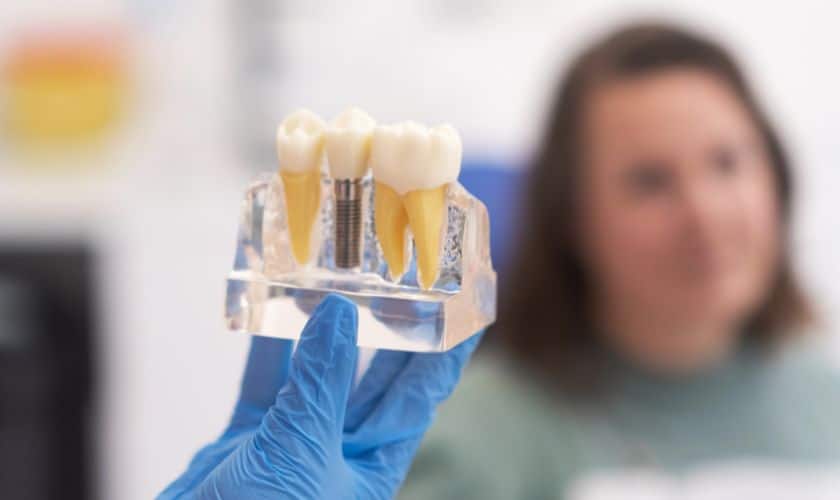
Are you tired of dealing with missing teeth that affect your confidence and daily life? Dental implants could be the perfect solution for you! Our Chandler dental practice offers top-notch implant treatments that can restore your smile’s functionality and aesthetics. Dental implants are durable, natural-looking replacements for missing teeth, providing a strong foundation for crowns, bridges, or dentures. With advanced technology and the expertise of our skilled team, you can experience a seamless implant procedure with minimal discomfort. Whether you’re missing a single tooth or multiple teeth, dental implants can rejuvenate your smile and boost your self-assurance. This blog will give an insight into dental implants, their benefits, the implant process, and aftercare tips for longevity. We understand that choosing dental implants is a significant decision, and we aim to equip you with all the information you need to make the best choice for your oral health. Don’t let missing teeth hold you back any longer—explore the possibilities of dental implants and rediscover your confidence in Chandler!
What Are Dental Implants?
Dental implants are innovative, artificial tooth roots surgically placed into the jawbone to provide a strong and stable foundation for replacement teeth. Made of biocompatible materials such as titanium, dental implants fuse with the natural bone over time through osseointegration. Unlike traditional dentures or bridges that sit on top of the gums, dental implants offer a more permanent solution for missing teeth. They restore your smile aesthetically and functionally by mimicking the look and feel of real teeth. Endosteal implants, the most common type, involve placing screws directly into the jawbone. Subperiosteal implants, on the other hand, utilize a metal frame placed beneath the gum tissue but above the jawbone surface. When replacing multiple adjacent teeth or an entire arch, implant-supported bridges or dentures can be used instead of individual dental implants. These options provide excellent stability and prevent further bone loss in areas where several teeth have been lost. With their remarkable ability to integrate seamlessly into your mouth’s structure and functions, dental implants have become one of the most sought-after solutions for restoring smiles beautifully and improving oral health.
Types of Dental Implants
When it comes to dental implants, there are different types available depending on your specific needs. Let’s explore some of these options:
- Endosteal Implants: These are the most common type of dental implants and involve placing a titanium screw directly into the jawbone. Once the implant integrates with the bone, a crown is attached, giving you a natural-looking tooth replacement.
- Subperiosteal Implants: This type of implant suits patients with insufficient jawbone structure to support traditional implants. Instead of being placed in the bone, subperiosteal implants sit on top or just below the gum line and are held in place by metal posts.
- All-on-4 Implants: If you’re missing multiple teeth or require full arch restoration, all-on-4 implants may be an excellent option. This technique involves placing four strategically positioned implants supporting an entire set of artificial teeth.
- Mini Implants: Mini implants are smaller than standard dental implants and require less invasive surgery. They are often used for patients with limited bone density or those seeking temporary tooth replacements.
The Process Of Getting Dental Implants
Getting dental implants is a multi-step procedure that requires careful planning and precision. It begins with an initial consultation where your dentist will assess your oral health and determine if you are a suitable candidate for implants. Once it has been determined that you are eligible for the procedure, the next step is to create a personalized treatment plan. This involves taking detailed images and measurements of your mouth to ensure accurate placement of the implants. Before the implantation, any necessary extractions or bone grafting may be performed to prepare the area for implant placement. This ensures that there is sufficient bone density to support the implants. On the day of the surgery, local anesthesia will be administered to numb the treated area. The dentist will then carefully insert titanium posts into your jawbone, which serve as artificial roots for your new teeth. After this initial surgery, a healing period of several months is required to allow osseointegration – the process by which the implants fuse with your natural bone – to occur. During this time, temporary crowns or dentures may be worn. Once osseointegration is complete and your gums have healed, abutments are attached to the implant posts. These abutments act as connectors between the implants and replacement teeth crowns. Custom-made crowns are created based on impressions taken during previous appointments. These crowns are then securely attached to the abutments, completing your smile transformation!
The Benefits Of Dental Implants
Dental implants offer numerous benefits that go beyond just replacing missing teeth. One of the key advantages is their ability to restore your smile and boost your self-confidence. With dental implants, you can regain a natural-looking and functional set of teeth that allows you to eat, speak, and laugh confidently. Another benefit of dental implants is their durability. Unlike dentures or bridges, which may need replacing over time, dental implants are designed to last many years with proper care. They are made from high-quality materials such as titanium and porcelain that are resistant to decay and staining. Moreover, dental implants help preserve the health of your jawbone. When you lose a tooth, the surrounding bone can deteriorate over time. Dental implants act as artificial tooth roots that stimulate the jawbone and prevent bone loss. This not only maintains the shape of your face but also provides support for neighboring teeth. Additionally, dental implants offer improved comfort compared to other tooth replacement options. Since they are securely anchored in your jawbone, there is no risk of them slipping or moving while eating or speaking like traditional dentures might do. Furthermore, dental implants promote better oral hygiene practices since they do not require any special cleaning routines or adhesives like removable dentures do. You can brush and floss them along with your natural teeth! The benefits of dental implants extend far beyond filling gaps in your smile. They provide long-lasting results, preserve jawbone health, improve comfort and stability while eating or speaking, and simplify oral hygiene maintenance.
Dental implants offer a solution that restores your missing teeth and gives you the self-assurance to take on the world with a radiant smile. Their natural look and feel blend seamlessly into your mouth, making them virtually indistinguishable from your real teeth. Dental implants are reliable and long-lasting for restoring function and aesthetics, whether missing one tooth or several. They provide stability and support that traditional dentures or bridges cannot match. Getting dental implants may require time and patience, but the result is well worth it. From the initial consultation to the final placement of the implant crown, every step is carefully planned and executed by skilled professionals who prioritize your comfort.